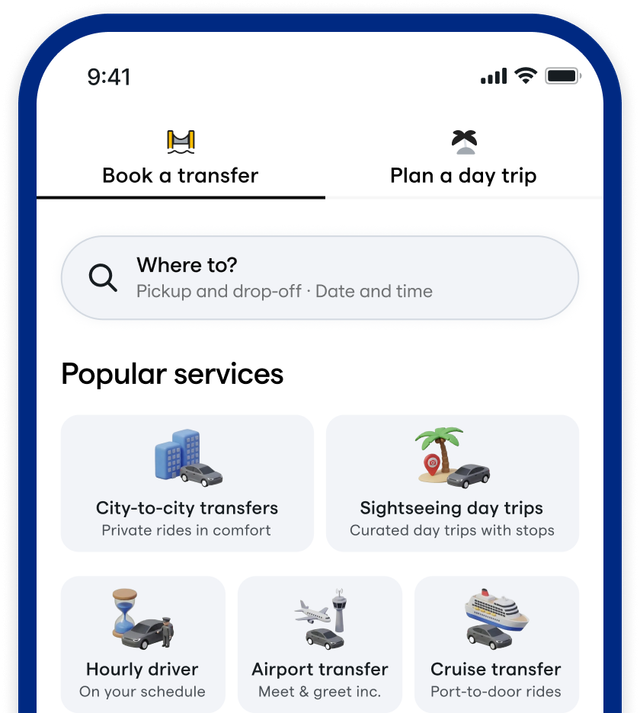
Daytrip is a private car service platform that connects you with local drivers who will transport you door-to-door. We also give you the opportunity to explore sights/attractions along the way. We drive, you discover.
Daytrip offers private door-to-door transfers with optional sightseeing stops, hourly driver hire, and curated day trips — all with local English-speaking drivers and operating across 130+ countries.
The cancellation policy may vary depending on your trip. The cancellation conditions available for your booking will always be shown before confirming your trip. Depending on eligibility, Daytrip offers different cancellation options:
Non-refundable: If your trip is canceled after confirmation, the amount paid will not be refunded.
Standard: If your trip is canceled at least 24 hours before the scheduled departure time, the amount paid will be refunded in full. Cancellations made less than 24 hours before departure are not eligible for a refund.
Flexible: If your trip is canceled at least 1 hour before the scheduled departure time, the amount paid will be refunded in full. Cancellations made less than 1 hour before departure are not eligible for a refund.
Trips booked less than 24 hours before departure may not be eligible for free cancellation unless stated otherwise during the booking process.
Yes! Book a private, door-to-door airport transfer with a local English-speaking driver. Enjoy fixed and transparent pricing, no hidden fees, and the option to pay in advance without the hassle of exchanging cash at a foreign airport.
You will receive the vehicle that best fits the number of travelers in your group, ranging from a sedan to a van for groups of up to 7. Depending where you travel, you can book anything from a sedan comparable to a Toyota Corolla to a Mercedes V-Class to a Classic Cuban Car. While the exact model may vary, we always ensure that the vehicle provided meets your needs in terms of safety, reliability, and comfort. You may be upgraded to a larger vehicle class free of charge depending on availability. Since our largest vehicle seats 7, for groups larger a combination of vehicles will be used. We will send you the exact vehicle details a few days before your trip.
Everywhere except the USA, drivers will supply appropriate child seats (just let us know during booking). In the USA, certain states require you to supply your own child seats.
2+ million travelers like you. Moments they'll never forget.
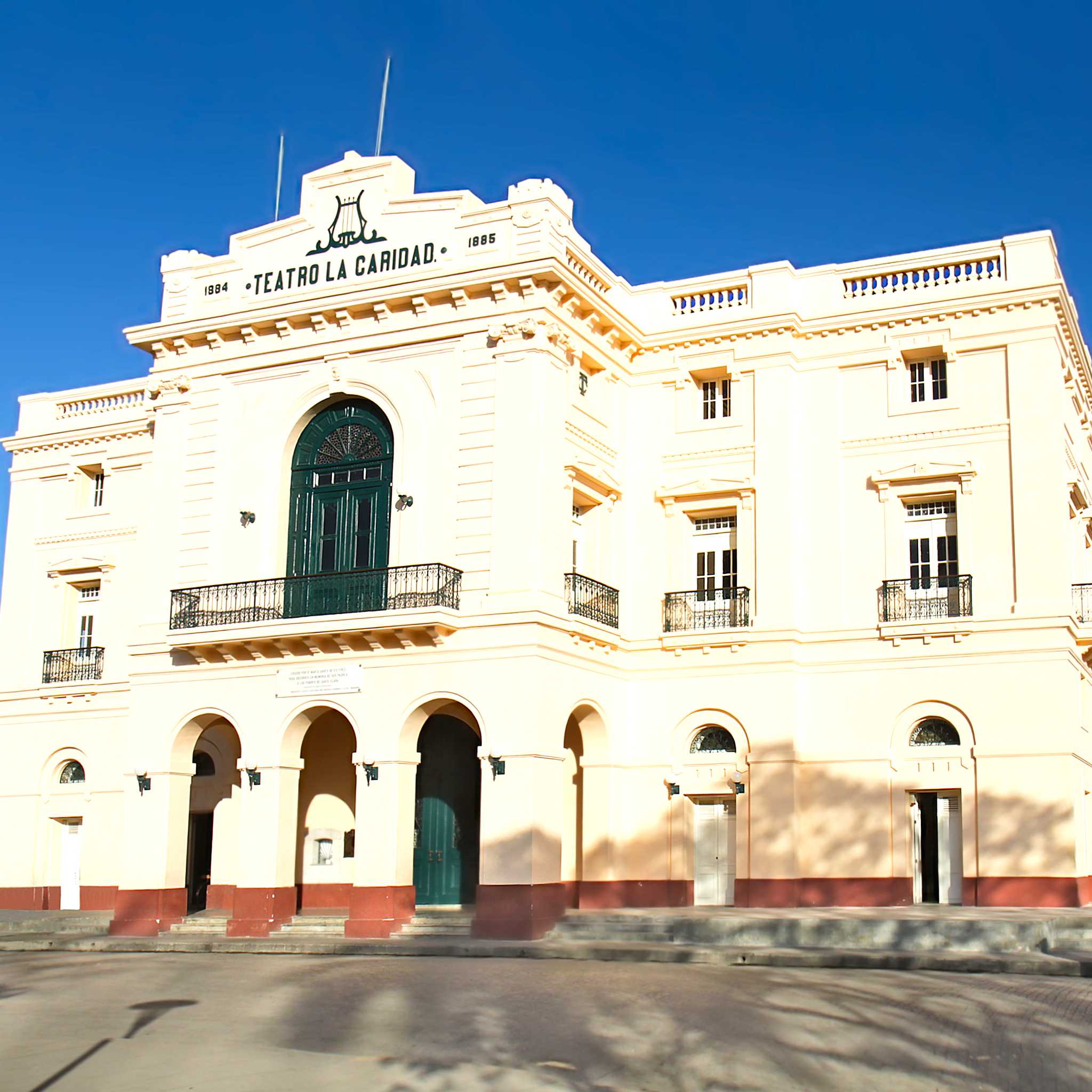
Parque Vidal is the city's social heart, ringed by grand buildings like the Teatro La Caridad, the Santa Clara Libre hotel, and the former city hall, plus a statue honoring Marta Abreu, the philanthropist who shaped much of the city. From there, Calle Independencia offers a genuine local shopping strip, a good contrast to the more polished tourist areas elsewhere in Cuba.
Santa Clara sits roughly 270-300 km (168-186 miles) from Havana, about a 3 to 4 hour drive via the Autopista Nacional. A private transfer means one direct ride at a time you choose, instead of working around a bus timetable. Coming from Trinidad or Cienfuegos, Santa Clara is much closer, under 100 km (62 miles), typically 1 to 2 hours, making it an easy add-on to a trip through central Cuba.
Most travelers cover the highlights comfortably in three to four hours on the ground: the Che Guevara Mausoleum and Museum, the armored train monument, Parque Vidal, and Calle Independencia. A private transfer lets you set your own pace, linger longer at the museum, or wrap up early if you're combining Santa Clara with another stop along the way.
During the 1958 battle, Che and his small guerrilla unit derailed a train carrying government troops and weapons sent to reinforce Batista's army, a bold move that helped seal the city's fall. The site now preserves the actual derailed train cars as an open-air monument, with a small museum of weapons and photos from that pivotal fight. It's one of the few places in Cuba where you can stand at the exact spot history turned.
The mausoleum holds the remains of Che Guevara and 16 fellow guerrillas killed alongside him in Bolivia, brought back to Santa Clara for burial. Next door, the museum walks through his life from childhood in Argentina to the battle that helped win Cuba for Fidel Castro. Photographs, personal artifacts, and letters give the site a personal weight that goes beyond the famous image on a t-shirt.
Santa Clara isn't just another Cuban city, it's where the Revolution was actually won. In 1958 Che Guevara led the decisive Battle of Santa Clara here, and that history still shapes the city today, from his mausoleum to the armored train he famously derailed. Add a grand central park, elegant 19th century architecture, and a lively local shopping street, and you get a day that mixes major history with everyday Cuban life, well off the typical tourist trail.