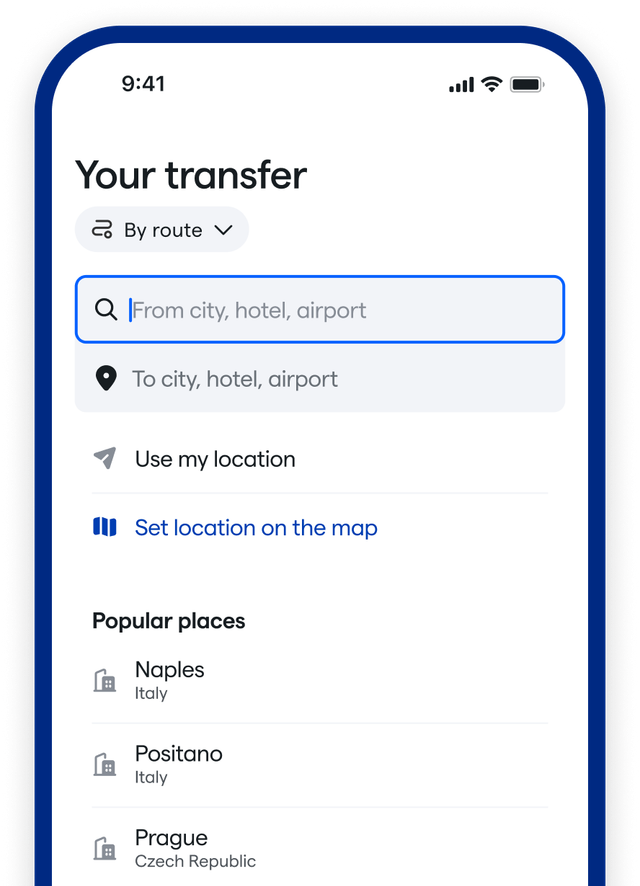
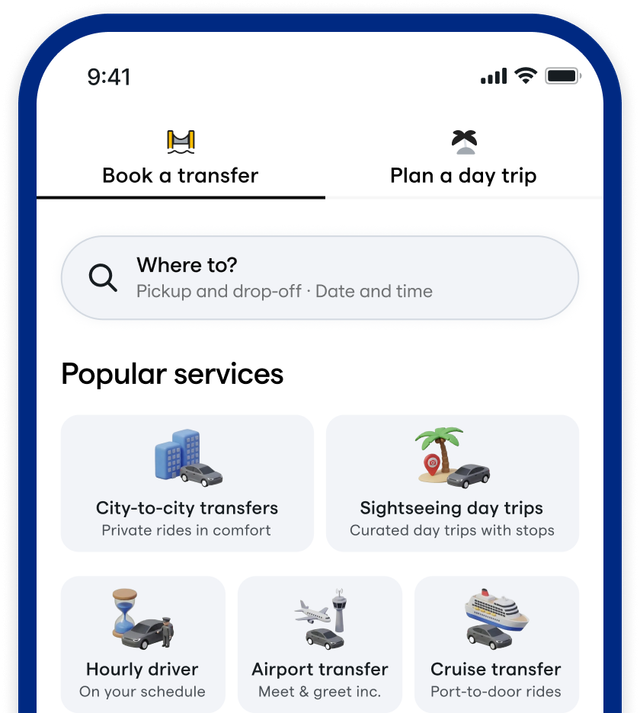
Daytrip is a private car service platform that connects you with local drivers who will transport you door-to-door. We also give you the opportunity to explore sights/attractions along the way. We drive, you discover.
Daytrip offers private door-to-door transfers with optional sightseeing stops, hourly driver hire, and curated day trips — all with local English-speaking drivers and operating across 130+ countries. You can also book on our Daytrip app, which is available on the Apple App Store and Google Play Store.
The cancellation policy may vary depending on your trip. The cancellation conditions available for your booking will always be shown before confirming your trip. Depending on eligibility, Daytrip offers different cancellation options:
Non-refundable: If your trip is canceled after confirmation, the amount paid will not be refunded.
Standard: If your trip is canceled at least 24 hours before the scheduled departure time, the amount paid will be refunded in full. Cancellations made less than 24 hours before departure are not eligible for a refund.
Flexible: If your trip is canceled at least 1 hour before the scheduled departure time, the amount paid will be refunded in full. Cancellations made less than 1 hour before departure are not eligible for a refund.
Trips booked less than 24 hours before departure may not be eligible for free cancellation unless stated otherwise during the booking process.
Yes! Book a private, door-to-door airport transfer with a local English-speaking driver. Enjoy fixed and transparent pricing, no hidden fees, and the option to pay in advance without the hassle of exchanging cash at a foreign airport.
You will receive the vehicle that best fits the number of travelers in your group, ranging from a sedan to a van for groups of up to 7. Depending where you travel, you can book anything from a sedan comparable to a Toyota Corolla to a Mercedes V-Class to a Classic Cuban Car. While the exact model may vary, we always ensure that the vehicle provided meets your needs in terms of safety, reliability, and comfort. You may be upgraded to a larger vehicle class free of charge depending on availability. Since our largest vehicle seats 7, for groups larger a combination of vehicles will be used. We will send you the exact vehicle details a few days before your trip.
Everywhere except the USA, drivers will supply appropriate child seats (just let us know during booking). In the USA, certain states require you to supply your own child seats.
Copacabana is small and walkable, though the altitude makes uphill walking challenging. Boats are needed to visit nearby islands like Isla del Sol.
The Copacabana beachfront promenade is flat, wide, and well-paved, making it one of Rio's most accessible areas for strollers and wheelchairs. The beach itself has some accessibility ramps. Other parts of Rio, including hillside attractions like Christ the Redeemer, have improved accessibility options such as accessible vans and elevators.
Copacabana is heavily visited and generally safe along the beachfront and main streets during the day. At night, stick to well-lit areas and avoid displaying valuables. It is advisable to leave passports and expensive jewelry at your hotel. Stay aware of your surroundings and follow current local advice.
Enjoy spectacular Lake Titicaca views, take boat trips to Isla del Sol, hike to Cerro Calvario for sunset views, and experience traditional Andean culture and markets.
Must-sees include the Christ the Redeemer statue, Sugarloaf Mountain, the Selarón Steps, and neighboring Ipanema beach. The Copacabana beachfront promenade is great for a stroll, and the nearby Santa Teresa neighborhood offers a bohemian arts scene. Hang gliding over the city from Pedra Bonita is a bucket-list experience.
Bolivia uses the Boliviano (BOB). US dollars are widely accepted in tourist areas and hotels, but local currency is needed for small purchases and markets.
Brazil uses the Brazilian real (BRL). Cash is widely used, especially at beach kiosks, markets, and smaller establishments. Cards are accepted in most hotels and larger restaurants. ATMs are available throughout Copacabana, but notify your bank before traveling to avoid issues with international withdrawals.
In Brazil, a 10 percent service charge is often added to restaurant bills. If not included, rounding up or leaving 10 percent is appreciated. Tipping is not as deeply ingrained as in some other countries, but small tips for hotel staff, drivers, and attentive service are always welcome.
Portuguese is the official language of Brazil. Unlike the rest of South America, Brazil does not speak Spanish. In Copacabana and other visitor-heavy areas of Rio, English is spoken in many hotels and larger restaurants, but less commonly in everyday settings, so a few Portuguese phrases go a long way.
Spanish is the official language. Indigenous languages like Quechua and Aymara are also spoken. English is limited, so basic Spanish is very helpful.
Copacabana sits at 12,600 feet (3,841 meters) above sea level. Take it easy in your first days, stay hydrated, avoid alcohol initially, and consider altitude sickness medication.
Pack layers for temperature changes - warm clothes for cold nights and lighter clothing for sunny days. Sunscreen is essential at this altitude.
Try a classic churrasco (Brazilian barbecue), feijoada (black bean and pork stew), and pao de queijo (cheese bread). On the beach, look for vendors selling mate tea, biscoito Globo snacks, and fresh coconut water. Acai bowls are a local staple and widely available.
The best time to visit is from May to October, when the weather is warm and dry. November through March is hot and humid with frequent rain. Carnival in February or March is an extraordinary cultural experience but brings large crowds and higher prices. December and January are peak summer season for Brazilians.
May through September is the dry season with sunny days and cool nights. This offers the best weather for outdoor activities and Lake Titicaca boat trips.