Yes, and the geography of the Alpilles makes this particularly well-suited to combination visits. Saint-Rémy-de-Provence is roughly 20 km (12 miles) to the north and holds the Roman monuments of Glanum alongside Saint-Paul-de-Mausole, the asylum where Van Gogh voluntarily committed himself and painted some of his most celebrated works. Arles, around 30 km (19 miles) to the southwest, offers Roman amphitheater ruins and the city's deep connection to Van Gogh's time in Provence. Together with Les Baux, these form a natural loop through some of the most historically layered countryside in France. A Daytrip driver familiar with the region can connect these stops in sequence, making the drive through the Alpilles part of the experience rather than time spent navigating.
Les Baux sits roughly 30 km (19 miles) northeast of Arles, around 20 km (12 miles) south of Saint-Rémy-de-Provence, and approximately 80 km (50 miles) west of Aix-en-Provence. The village has no train station and is not practically reachable by public transport — the nearest bus connections are limited and do not run to a schedule that suits a day visit. The road leading up to Les Baux is narrow, and parking is located below the village on the approach road rather than in the historic center. A private transfer removes these logistics entirely: your driver drops you directly at the village entrance, you spend your time inside rather than managing a car, and you leave whenever you are ready.
It works well for families, particularly with children who have some interest in history or who respond well to visual spectacle. Carrières de Lumières tends to capture younger imaginations strongly — the scale of the projections and the enveloping sound design create an experience that lands differently than a conventional museum. The Château des Baux ruins offer outdoor space to roam, and the working siege weapons on site are consistently a highlight for children. The village itself is compact enough that a day here does not involve long distances on foot. Traveling by private transfer also removes one of the more stressful elements of visiting a hillside village with children: there is no need to manage car seats, find parking, or walk a long approach road carrying bags.
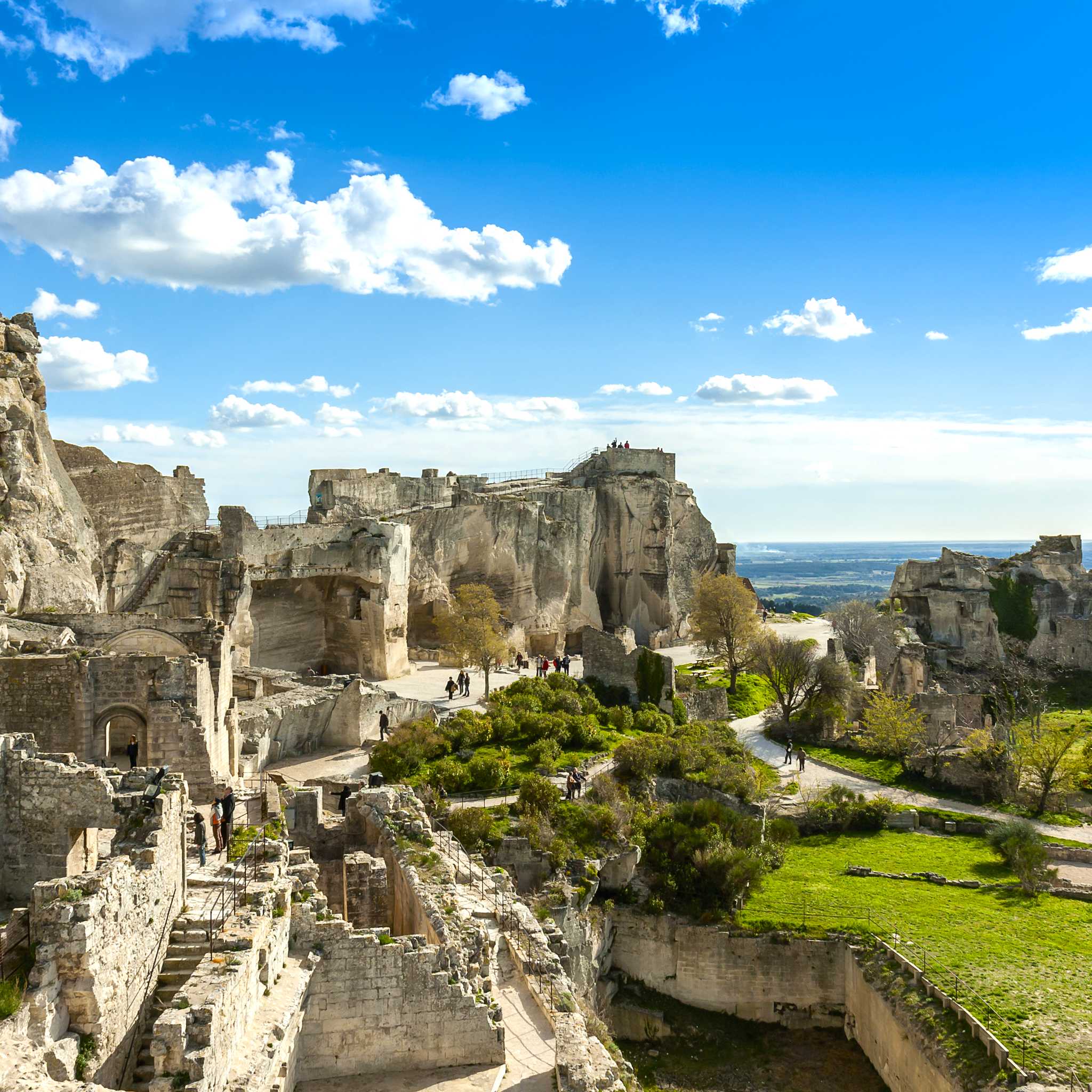
The three anchors of a day here are Carrières de Lumières, the Château des Baux ruins, and the medieval village itself. Carrières de Lumières changes its main show annually, typically featuring immersive floor-to-ceiling projections inspired by major artists or artistic movements — plan for at least an hour inside the quarry, more if you want to fully absorb the experience. The Château des Baux ruins sit at the very top of the spur and reward exploration: the views from the ramparts across the Alpilles are exceptional, and the site includes working trebuchets and catapults that add a tangible sense of medieval scale. The village streets below are lined with artisan studios, regional food shops, and galleries worth browsing. Five to six hours gives a relaxed, unhurried visit that covers all three without rushing.
Les Baux-de-Provence earns its reputation as one of the most striking villages in France. Perched on a spur of the Alpilles limestone range, the medieval citadel rises dramatically above the surrounding olive groves and garrigue scrubland, giving the whole landscape a quality that feels almost theatrical. The ruined Château des Baux dates to the 10th century and was once one of the most powerful lordships in Provence. But the experience that draws the most visitors today is Carrières de Lumières — an immersive digital art show projected across the vast interior of an old quarry. The combination of ancient fortress ruins, extraordinary natural terrain, and a world-class contemporary art installation in a single compact site is genuinely rare. Most visitors arrive expecting a pretty village and leave having had something considerably more memorable.
Les Baux is a genuinely small site, and its fame means it draws significant crowds, particularly in summer and around holiday periods. Arriving in the morning tends to offer a quieter experience before day-trippers arrive in numbers. The terrain is uneven — the village streets and the Château des Baux ruins both involve cobblestones and steep inclines, so comfortable, sturdy footwear matters more than in most destinations. The Carrières de Lumières quarry can be cool even in warm weather, so a light layer is worth having. Most visitors who feel the experience fell flat cite arriving mid-afternoon in peak season as the main factor; those who plan their timing find it one of the most atmospheric places in southern France.
Daytrip은 현지 운전기사와 연결해주는 프라이빗 차량 서비스 플랫폼으로, 고객님을 문 앞까지 안전하게 모셔다 드립니다. 또한 이동 중에 다양한 명소와 관광지를 탐방할 수 있는 기회도 제공합니다. 저희가 운전하고, 여러분은 새로운 곳을 발견하세요.
Daytrip은 현지 영어 구사 운전기사가 운전하는 프라이빗 도어 투 도어 이동 서비스, 선택 가능한 관광지 정차, 시간제 기사 대여, 엄선된 당일 여행을 130개국 이상에서 제공합니다.
취소 정책은 여행에 따라 다를 수 있습니다. 예약 시 적용되는 취소 조건은 여행을 확정하기 전에 항상 표시됩니다. 자격 요건에 따라 Daytrip은 다양한 취소 옵션을 제공합니다:
환불 불가: 여행이 확정된 후 취소할 경우, 결제하신 금액은 환불되지 않습니다.
표준: 예정된 출발 시간 최소 24시간 전까지 여행을 취소하면 결제하신 금액이 전액 환불됩니다. 출발 24시간 미만 전에 취소하는 경우 환불이 불가합니다.
유연: 예정된 출발 시간 최소 1시간 전까지 여행을 취소하면 결제하신 금액이 전액 환불됩니다. 출발 1시간 미만 전에 취소하는 경우 환불이 불가합니다.
출발 24시간 미만 전에 예약한 여행은 예약 과정에서 별도의 안내가 없는 한 무료 취소가 불가할 수 있습니다.
네! 현지 영어 가능 기사와 함께하는 프라이빗 도어 투 도어 공항 이동 서비스를 예약하세요. 고정되고 투명한 요금, 숨겨진 비용 없이 이용할 수 있으며, 해외 공항에서 현금을 환전하는 번거로움 없이 미리 결제할 수 있는 옵션도 제공합니다.
여행 인원 수에 가장 적합한 차량을 받게 되며, 인원이 최대 7명인 그룹의 경우 세단부터 밴까지 다양하게 제공됩니다. 여행하시는 지역에 따라 토요타 코롤라와 비슷한 세단부터 메르세데스 V-클래스, 클래식 쿠바 자동차까지 예약하실 수 있습니다. 정확한 차량 모델은 달라질 수 있지만, 항상 안전성, 신뢰성, 편안함 측면에서 고객님의 요구를 충족하는 차량을 제공합니다. 차량의 재고 상황에 따라 무료로 더 큰 차량으로 업그레이드될 수 있습니다. 최대 7인승 차량이 가장 크기 때문에, 7명 이상인 경우에는 여러 대의 차량이 조합되어 제공됩니다. 여행 며칠 전에 정확한 차량 정보를 안내해 드리겠습니다.
미국을 제외한 모든 지역에서는 운전자가 적절한 어린이용 카시트를 제공합니다(예약 시 알려주시면 됩니다). 미국의 경우, 일부 주에서는 고객이 직접 어린이용 카시트를 준비해야 합니다.
페루 리마를 여행하는 동안 두 번의 개인 이동 서비스를 예약하기 위해 이 웹사이트를 우연히 발견하게 되어 정말, 정말 기뻤습니다. 두 번 모두 약 3시간 정도의 편도 이동이었습니다. 예약을 이메일로 완료한 직후부터 소통이 매우 좋았고, 이후에는 앱도 다운로드했습니다. 앱 사용 중 몇 가지 문제가 있었지만 고객 서비스가 정말 훌륭하게 도와주며 해결하려고 노력해 주었습니다. 솔직히 고객 서비스가 매우 인상적이었고, 올바른 선택을 했다는 좋은 느낌을 받았습니다. 두 명의 기사님 모두 정확히 제시간에 도착했고 전혀 문제가 없었습니다! 이렇게 먼 곳을 여행할 때 서비스가 얼마나 훌륭하고 모든 과정이 얼마나 편리했는지 아무리 말해도 부족합니다. Daytrip 팀에 큰 박수를 보냅니다! 강력히 추천합니다.