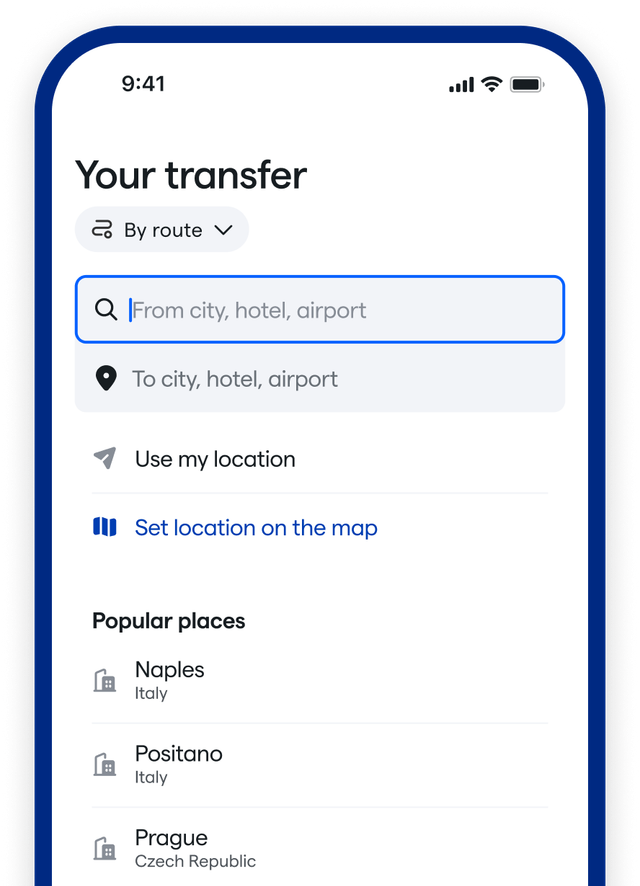
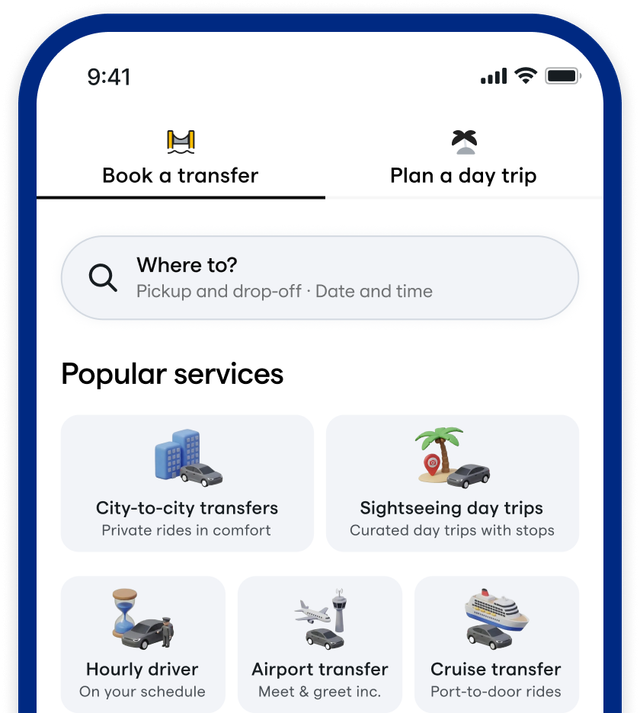
Daytrip is a private car service platform that connects you with local drivers who will transport you door-to-door. We also give you the opportunity to explore sights/attractions along the way. We drive, you discover.
Daytrip offers private door-to-door transfers with optional sightseeing stops, hourly driver hire, and curated day trips — all with local English-speaking drivers and operating across 130+ countries.
The cancellation policy may vary depending on your trip. The cancellation conditions available for your booking will always be shown before confirming your trip. Depending on eligibility, Daytrip offers different cancellation options:
Non-refundable: If your trip is canceled after confirmation, the amount paid will not be refunded.
Standard: If your trip is canceled at least 24 hours before the scheduled departure time, the amount paid will be refunded in full. Cancellations made less than 24 hours before departure are not eligible for a refund.
Flexible: If your trip is canceled at least 1 hour before the scheduled departure time, the amount paid will be refunded in full. Cancellations made less than 1 hour before departure are not eligible for a refund.
Trips booked less than 24 hours before departure may not be eligible for free cancellation unless stated otherwise during the booking process.
Yes! Book a private, door-to-door airport transfer with a local English-speaking driver. Enjoy fixed and transparent pricing, no hidden fees, and the option to pay in advance without the hassle of exchanging cash at a foreign airport.
You will receive the vehicle that best fits the number of travelers in your group, ranging from a sedan to a van for groups of up to 7. Depending where you travel, you can book anything from a sedan comparable to a Toyota Corolla to a Mercedes V-Class to a Classic Cuban Car. While the exact model may vary, we always ensure that the vehicle provided meets your needs in terms of safety, reliability, and comfort. You may be upgraded to a larger vehicle class free of charge depending on availability. Since our largest vehicle seats 7, for groups larger a combination of vehicles will be used. We will send you the exact vehicle details a few days before your trip.
Everywhere except the USA, drivers will supply appropriate child seats (just let us know during booking). In the USA, certain states require you to supply your own child seats.
2+ million travelers like you. Moments they'll never forget.
Ait Benhaddou sits roughly 32 km (20 miles) northwest of Ouarzazate, making it a natural pairing with a visit to that city's famous film studios. From Marrakech, the distance is approximately 200 km (125 miles), crossing over or through the High Atlas Mountains via the Tizi n'Tichka pass — a mountain road that is itself a highlight of the journey. Many travelers find that the drive from Marrakech is half the experience, with dramatic scenery unfolding at every turn.
Plan for around two to three hours inside the ksar itself. That's enough time to cross the riverbed approach, wander the labyrinthine interior lanes, visit a few of the traditional homes and their artefacts, and make the climb to the granary at the top for panoramic views over the surrounding valley. If you linger over a guided tour or browse the artisan stalls, you can stretch it to three hours comfortably. The village is compact by design — its tight quarters and narrow windows were built for communal defense, not leisurely strolling — so it rewards slow, curious exploration rather than rushing.
Yes, and it is specifically recommended for this site. The architecture at Ait Benhaddou follows construction principles identical to those used centuries before the current structures were built, and much of what you see — the mosque, the community square, the fortification layout — only makes sense with context. A guide will also point out the filming locations hidden within the narrow alleys, identify traditional artefacts inside the residential quarters, and explain how the ksar functioned as a living community on the trans-Saharan caravan route. Without that context, it is easy to admire the views while missing the depth of what you are actually looking at.
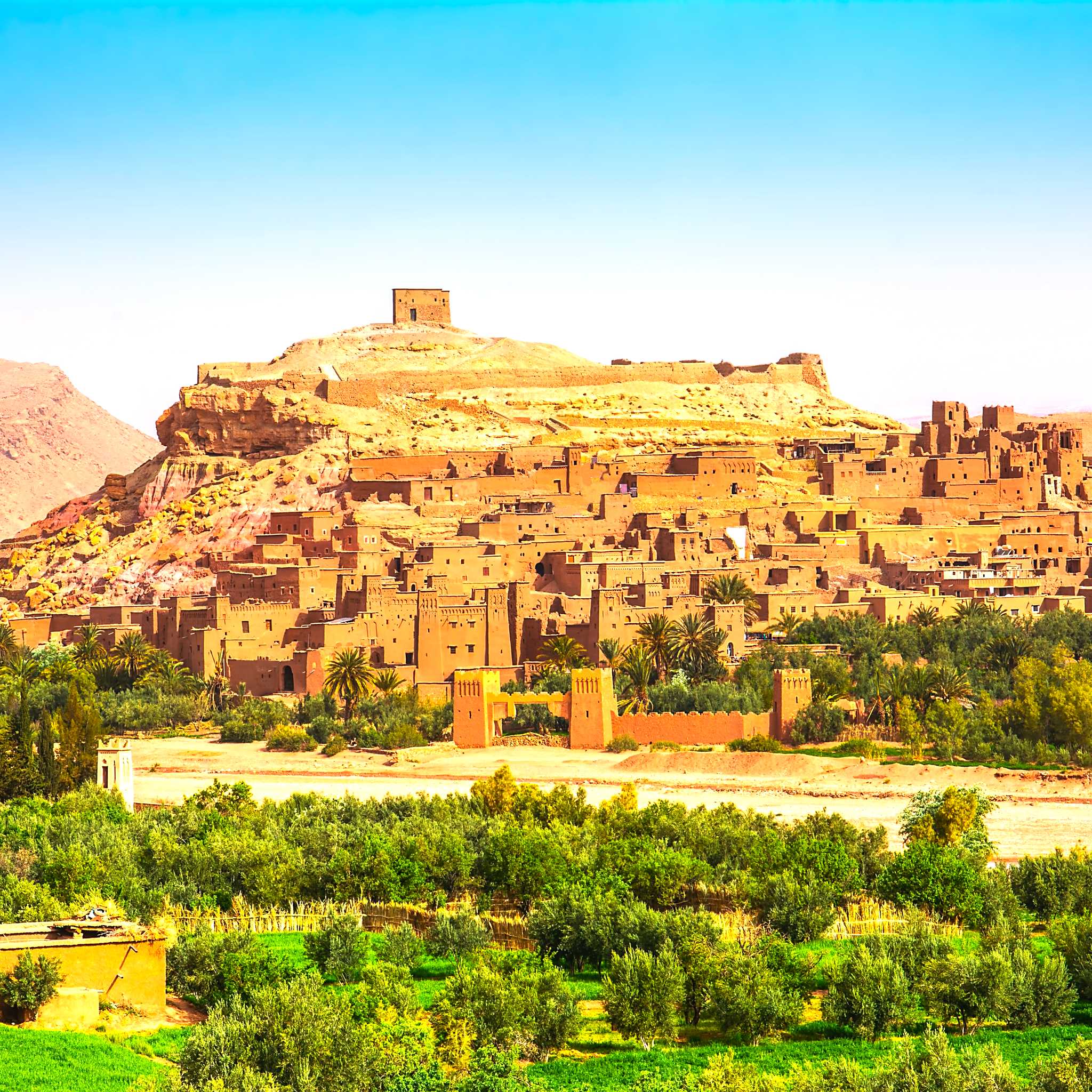
Ait Benhaddou is a fortified village, or ksar, rising dramatically from the banks of the Ounila River in southern Morocco. Built from earthen clay and straw, its towering pisé walls and honey-colored towers have stood as a testament to pre-Saharan architecture since the 17th century — though the building techniques go back centuries further. It sits along a historic caravan route that once connected the Sahara to Marrakech, earning it the nickname "door to the desert." A day trip gives you exactly enough time to explore its winding lanes, climb to the granary at the summit for sweeping views, and soak in a landscape that has captivated filmmakers, historians, and travelers alike.
The journey from Marrakech crosses the High Atlas via the Tizi n'Tichka mountain pass, a winding road where public transport options are limited and connections can be unreliable. A private transfer is the practical choice — it lets you depart on your own schedule, stop for photos along the pass, and return when you are ready rather than chasing a timetable. Daytrip's drivers know the route well and can incorporate stops at viewpoints or villages along the way, so the 200 km (125 miles) each way becomes part of the experience rather than time lost in transit.
The ksar has served as a backdrop for some of cinema's most recognizable productions, drawn by its ancient, otherworldly appearance. Walking through its gates, you'll recognize scenes from productions you've almost certainly seen. Some buildings now house small shops and artisan stalls, while others preserve traditional artefacts that give a genuine sense of daily life in a pre-Saharan community. A local guided tour is highly recommended — guides bring the film history and kasbah culture to life in ways a self-guided walk simply cannot match.