Arromanches sits about 10 km (6 miles) from Bayeux and 30 km (19 miles) from Caen, with Paris roughly 270 km (170 miles) away, a drive of around 3 to 3.5 hours depending on traffic. Arromanches has no train station of its own, so travelers relying on rail still need a taxi or transfer for the final stretch from Bayeux or Caen. A private transfer covers the whole route door to door in one vehicle, which saves the most time on the longer run from Paris.
Half a day covers the highlights well: the museum, the cinema, and a walk along the beach to see the harbor remains up close. The village is small and easily walkable, with the seafront, shops and viewpoints all within a few minutes of one another. Most travelers then use the rest of the day to add one or two nearby D-Day sites.
Yes, most travelers pair Arromanches with nearby sites along the same stretch of coast, such as Omaha Beach, the Normandy American Cemetery at Colleville-sur-Mer, or Pointe du Hoc. Moving between them in one day builds a fuller picture of D-Day, from the harbor and supply operation at Arromanches to the combat history at Omaha and the memorial grounds at Colleville. A private transfer makes it easy to string these sites together in the order and pace that suits you, rather than following a fixed tour bus route.
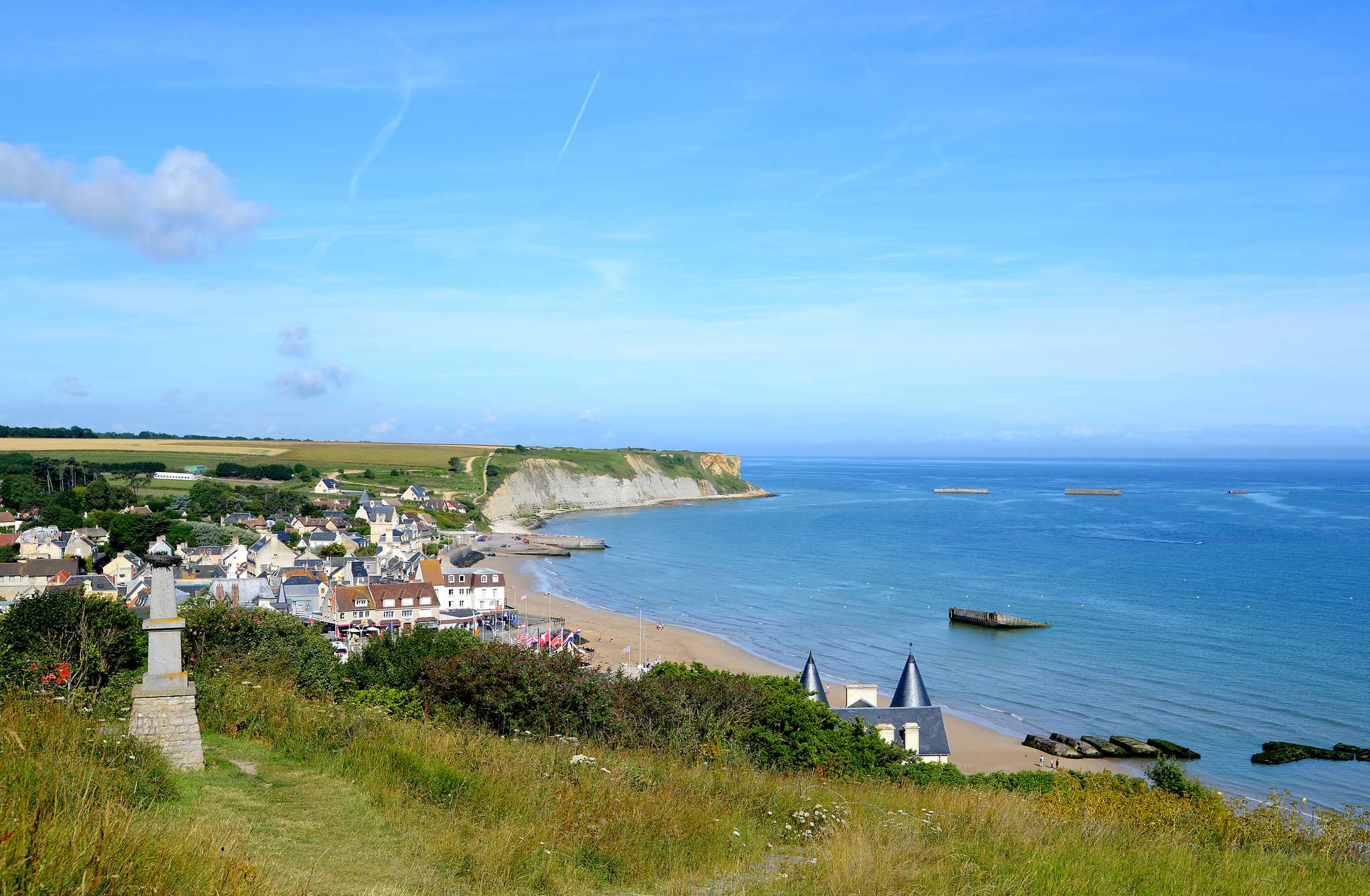
Yes. Long before 1944, Arromanches was a modest fishing village and, from the 1870s, a seaside holiday spot, and that character still sits alongside the war memorials today. Cliff-top paths above the town offer views over the harbor remains and the Channel, and the beach itself is a pleasant place to slow down after a morning in the museums. Few places combine such historical weight with an easy, genuine seaside feel.
The D-Day Museum on the seafront explains how Port Winston was designed and built in a matter of weeks, using detailed scale models, archival photos and salvaged equipment. A short walk up the cliff, the Arromanches 360 circular cinema surrounds you with archival footage on nine screens, recreating the intensity of the landings. Together, both sites take roughly two hours and cover the engineering achievement and the human experience side by side.
Arromanches is home to the remains of Port Winston, an artificial harbor towed across the English Channel and assembled offshore in June 1944 to supply the Allied advance. It is one of the few places on the Normandy coast where the physical scale of that logistics operation is still visible, with massive concrete blocks scattered along the beach and standing in the water at low tide. That tangible, still-standing evidence of the invasion is what sets it apart from many other D-Day sites.