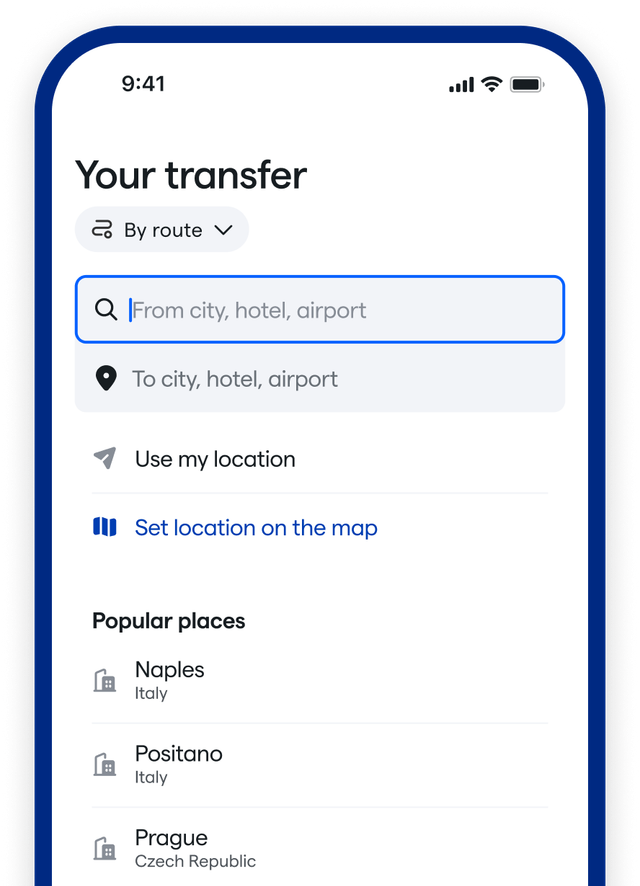
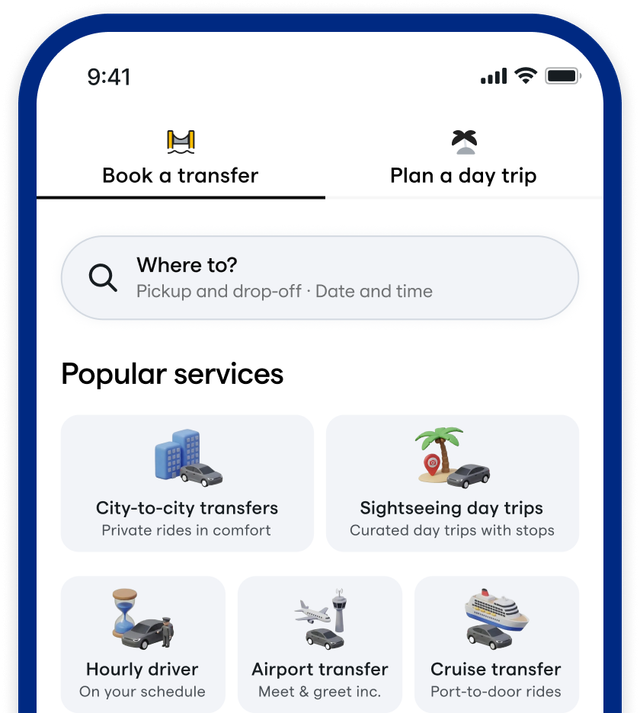
Daytrip is a private car service platform that connects you with local drivers who will transport you door-to-door. We also give you the opportunity to explore sights/attractions along the way. We drive, you discover.
Daytrip offers private door-to-door transfers with optional sightseeing stops, hourly driver hire, and curated day trips — all with local English-speaking drivers and operating across 130+ countries.
The cancellation policy may vary depending on your trip. The cancellation conditions available for your booking will always be shown before confirming your trip. Depending on eligibility, Daytrip offers different cancellation options:
Non-refundable: If your trip is canceled after confirmation, the amount paid will not be refunded.
Standard: If your trip is canceled at least 24 hours before the scheduled departure time, the amount paid will be refunded in full. Cancellations made less than 24 hours before departure are not eligible for a refund.
Flexible: If your trip is canceled at least 1 hour before the scheduled departure time, the amount paid will be refunded in full. Cancellations made less than 1 hour before departure are not eligible for a refund.
Trips booked less than 24 hours before departure may not be eligible for free cancellation unless stated otherwise during the booking process.
Yes! Book a private, door-to-door airport transfer with a local English-speaking driver. Enjoy fixed and transparent pricing, no hidden fees, and the option to pay in advance without the hassle of exchanging cash at a foreign airport.
You will receive the vehicle that best fits the number of travelers in your group, ranging from a sedan to a van for groups of up to 7. Depending where you travel, you can book anything from a sedan comparable to a Toyota Corolla to a Mercedes V-Class to a Classic Cuban Car. While the exact model may vary, we always ensure that the vehicle provided meets your needs in terms of safety, reliability, and comfort. You may be upgraded to a larger vehicle class free of charge depending on availability. Since our largest vehicle seats 7, for groups larger a combination of vehicles will be used. We will send you the exact vehicle details a few days before your trip.
Everywhere except the USA, drivers will supply appropriate child seats (just let us know during booking). In the USA, certain states require you to supply your own child seats.
2+ million travelers like you. Moments they'll never forget.
Yes. Daejeon has a clean and efficient metro system, a comprehensive bus network, and affordable taxis that make getting around straightforward. The city is also well-connected by Korea's KTX high-speed rail, placing it less than an hour from Seoul and under 30 minutes from Busan, making it an easy addition to a broader South Korea itinerary.
Tipping is not part of the culture in South Korea, and in many settings it can come across as unnecessary or even mildly impolite. Good service is considered a standard, and staff are paid fair wages without relying on gratuities. A warm thank-you is the most appropriate way to show appreciation.
Top attractions include the Daejeon Expo Science Park and its National Science Museum, the Yuseong Hot Springs district, the Hanbat Arboretum, Bomunsan Natural Park, and the glittering Expo Bridge that lights up after dark. The Gyekoksan Mountain Red Clay Trail is a unique and popular hiking experience just outside the city center.
The official currency is the South Korean Won (KRW). US dollars and other foreign currencies are not generally accepted for everyday transactions, so plan to exchange money or withdraw Won from local ATMs upon arrival. Currency exchange is available at the airport, major banks, and authorized exchange offices throughout the city.
Korean is the official language. English signage is increasingly common in Daejeon, especially around major attractions and transit hubs. Many hospitality workers speak some English, though Daejeon is less internationally-oriented than Seoul, so having a translation app handy is a helpful backup.
Daejeon has a distinctly local feel and is much less crowded with international visitors than Seoul, Busan, or Jeju. It is often called the Silicon Valley of South Korea due to its concentration of research institutions and tech hubs. That scientific identity coexists with natural parks, hot spring spas, and a genuine Korean food culture that feels rooted and unhurried.
Daejeon is known for skewered and grilled soondae (blood sausage), hearty bean sprout soup (kongnamul gukbap), and fresh tofu dishes. The Eunhaengdong financial district transforms into a street food haven at night, offering a wide variety of Korean snacks and grilled foods. Exploring the local food alleys is a highlight for any visitor.
Spring (late March to May) is lovely, with cherry blossoms blooming across the city's parks and tree-lined streets. Fall (September to November) brings colorful foliage and mild temperatures perfect for hiking. Summers are hot and humid with a monsoon season from July to September, while winters are cold and dry.