Weimar sits in the cultural heart of Thuringia, making it an excellent stop when traveling between major cities. It works particularly well as a daylong cultural pause between Berlin and Munich, or as an enriching detour from the Leipzig-Dresden route. Erfurt, the regional capital with its medieval old town and famous bridge lined with houses, is just 20 km (12 miles) away. The historic Wartburg Castle, where Martin Luther translated the Bible, is about 80 km (50 miles) west. With a private transfer offering sightseeing stops, you can create a personalized route that captures multiple highlights in one journey rather than treating them as separate trips.
A private transfer is the most comfortable option, especially if you're coming from Berlin, Leipzig, or Dresden. From Leipzig, it's roughly 100 km (62 miles) and takes about 90 minutes. From Berlin, expect around 280 km (174 miles) taking approximately 2.5-3 hours. The advantage of a private transfer is door-to-door service without the hassle of navigating train connections, carrying luggage through stations, or working around fixed departure times. You can schedule your arrival and departure around the opening hours of specific museums, and if you discover you want to stay longer at the Anna Amalia Library or explore another garden, you have that flexibility.
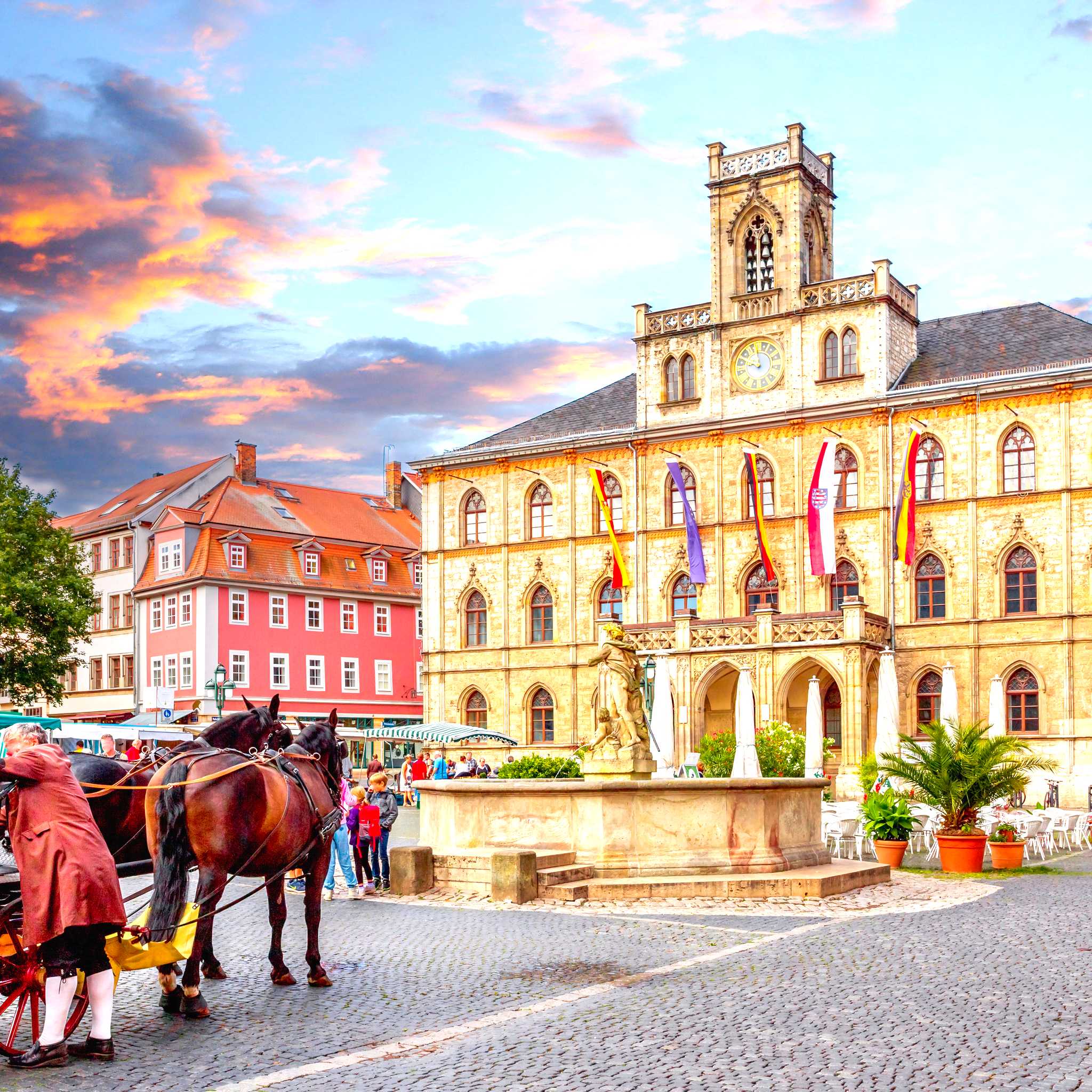
A full day gives you time to appreciate Weimar properly. Plan for 5-7 hours to visit the key sites: Goethe's House on Frauenplan, a stroll through Park an der Ilm to see the Garden House, the Bauhaus Museum, and the charming Old Town around the Market Square. If you're particularly interested in either the Classical period or Bauhaus architecture, you might focus your time accordingly. The compact layout means you'll spend more time exploring and less time navigating between attractions. With a private transfer, you can maximize your time in the city rather than dealing with train connections and schedules.
Yes. While Weimar's fame rests on its cultural titans, the experience is far more accessible than you might expect. Park an der Ilm alone is worth the visit—it's one of the most beautiful urban parks in Germany, with the Ilm River winding through lush greenery, romantic bridges, and hidden monuments. The Old Town offers charming streets, excellent cafes, and the lively Market Square. Even if you're not a Bauhaus expert, Haus am Horn is fascinating as a glimpse into radical early 20th-century living design. The city has a relaxed, human scale that makes it enjoyable simply to wander. Many visitors come for the "famous names" and leave most impressed by how pleasant and livable the city feels.
Absolutely. Weimar packs an extraordinary amount of cultural heritage into a compact, walkable city. You'll find two UNESCO World Heritage sites here: Classical Weimar (Goethe's and Schiller's homes, the stunning Duchess Anna Amalia Library) and the birthplace of the Bauhaus movement. The 58-hectare Park an der Ilm runs through the heart of the city and contains Goethe's Garden House where he wrote parts of Faust. Unlike sprawling tourist destinations, Weimar's main attractions are concentrated enough that you can experience the highlights comfortably in a single day without feeling rushed.
Weimar is where you'll find the soul of German Enlightenment culture concentrated in one remarkably preserved city. Goethe, Schiller, Bach, Liszt, and the entire Bauhaus movement all chose this small city as their creative home. Walking through Park an der Ilm, you're literally following in Goethe's footsteps through the same landscapes that inspired his greatest works. Then, just blocks away, you can see where Walter Gropius launched the revolutionary Bauhaus design movement at Haus am Horn. This juxtaposition of Classical and Modernist heritage in such an intimate setting is genuinely unique. It's often called "a park with a town attached" because the green spaces are so beautifully integrated into the urban fabric.