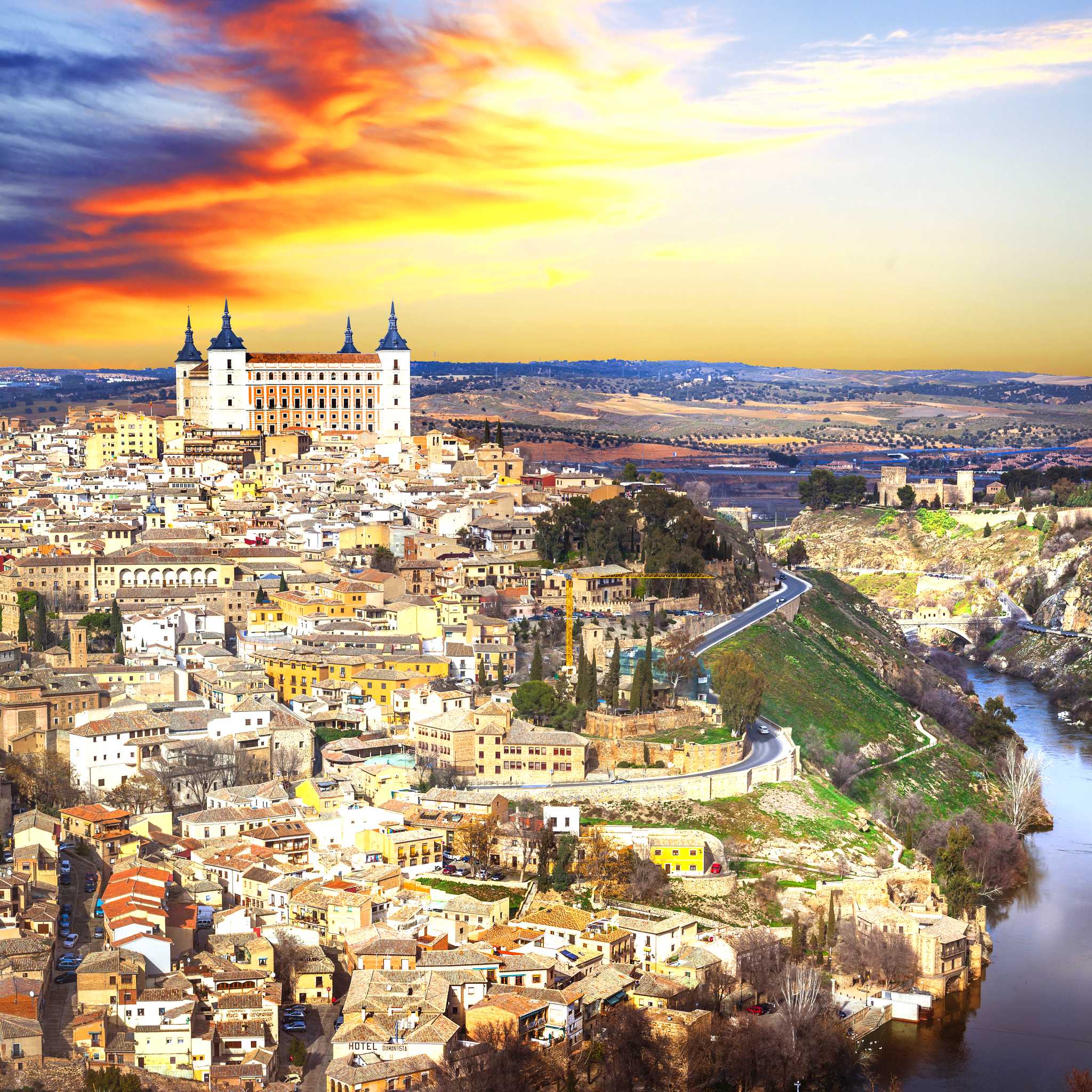
Yes. Since your transfer is private, you're not locked into a fixed route. You can ask your driver to pause at a scenic overlook of the city and the Tagus gorge, or work in another stop along the way. It's a flexible way to shape the day around what you actually want to see, rather than what a fixed schedule allows.
Toledo sits about 70 km (43 miles) south of Madrid, roughly a 45-60 minute drive. A private transfer takes you door-to-door on your own schedule, dropping you directly in the historic center rather than at a station outside the walls, so there's no timetable to work around and no uphill walk with luggage.
A single day is enough to see Toledo's highlights without feeling rushed. Most visitors spend around 4-6 hours in the historic center, which covers the cathedral, the Alcázar, and a walk through the old Jewish quarter. Since the city sits compactly on a hill within a bend of the Tagus River, the major sights are within a short walk of each other.
Toledo's historic center is compact and walkable, though the cobblestone streets can be steep and uneven. Wear comfortable, non-slip shoes and be prepared for some uphill walking between major attractions.
Toledo is generally very safe for travelers, with low crime rates. As with any historic city center, be aware of pickpockets in crowded tourist areas and keep valuables secure, especially near popular attractions.
Yes. Built in the 13th century, it's one of Spain's great cathedrals and widely regarded as the country's finest example of High Gothic style. The interior functions almost like a museum in its own right, with an altarpiece and other works by El Greco plus paintings by Rubens and Van Dyck in its gallery. Plan on at least an hour inside to do it justice.
Tipping is not mandatory in Spain but is appreciated for good service. In restaurants, rounding up the bill or leaving 5-10% is common. For taxis, rounding up to the nearest euro is standard practice.
Toledo Cathedral is a must-see Gothic masterpiece, along with the Alcazar fortress and El Greco Museum. The city's synagogues, mosques, and churches reflect its unique multicultural heritage as the "City of Three Cultures."
Start with the Cathedral, Spain's second-largest and widely considered its finest example of High Gothic architecture, with an altarpiece and paintings by El Greco alongside works by Rubens and Van Dyck. Then climb to the Alcázar, a hilltop fortress with roots in the 10th century that now houses a military museum. Finish at Santa María la Blanca, the oldest surviving synagogue building in Europe, tucked into the winding streets of the old Jewish quarter.
Spain uses the euro as its official currency. Credit cards are widely accepted in most establishments, but it's recommended to carry some cash for small purchases, tips, and visits to smaller local businesses.
Spanish (Castilian) is the official language spoken throughout Toledo and Spain. English is understood in many hotels, restaurants, and tourist attractions, but learning basic Spanish phrases is appreciated and helpful.
Try Toledo's famous marzipan, a sweet almond confection that originated in local convents. Other specialties include Manchego cheese, roast lamb, and perdiz (partridge). The region also produces excellent wines.
Spring (March-May) and fall (September-November) offer the most pleasant weather for exploring Toledo. Summer can be very hot, while winter is mild but may have shorter daylight hours for sightseeing.
For centuries, Toledo was a rare place where Christian, Muslim, and Jewish communities built side by side, and that layered history is still visible everywhere. It shows in the Mudéjar brickwork of Santa María la Blanca, a former synagogue built in Moorish style, in the Arab-founded Alcázar, and in a Gothic cathedral that itself rose on the site of a former mosque. Few cities pack this much overlapping heritage into such a walkable center.