Approuvé dans plus de 130 destinations dans le monde
Opérer dans le monde entier signifie que nous connaissons les meilleurs chemins, partout.
Assistance 24/7 sur laquelle vous pouvez compter
Avec Daytrip, vous n'êtes jamais seul. Obtenez l'aide dont vous avez besoin, à tout moment, n'importe où.
Des experts locaux au volant
Nos chauffeurs anglophones sont des professionnels vérifiés qui sont experts en itinéraires, conseils locaux et sécurité.
Flexibilité pour personnaliser votre voyage
Personnalisez votre voyage pour voir exactement ce que vous voulez, quand vous le voulez.
Sécurité et confiance, tout au long du parcours
Découvrez de nouveaux lieux en toute tranquillité, sachant que vous êtes en sécurité, à l'aise et à l'heure.
Voyages de dernière minute, réservations faciles
Réservez aujourd'hui, voyagez demain. Votre prochaine escapade est prête quand vous l'êtes.
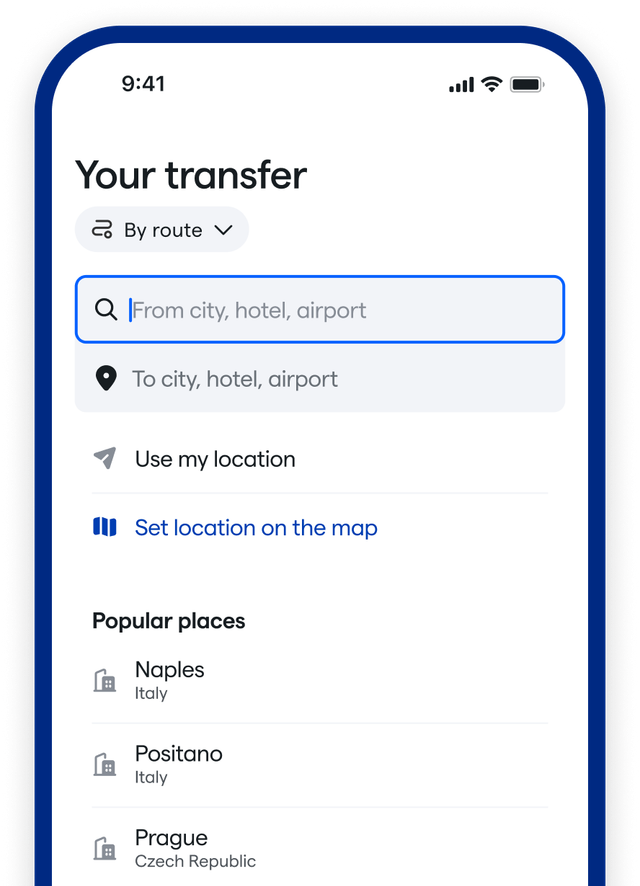
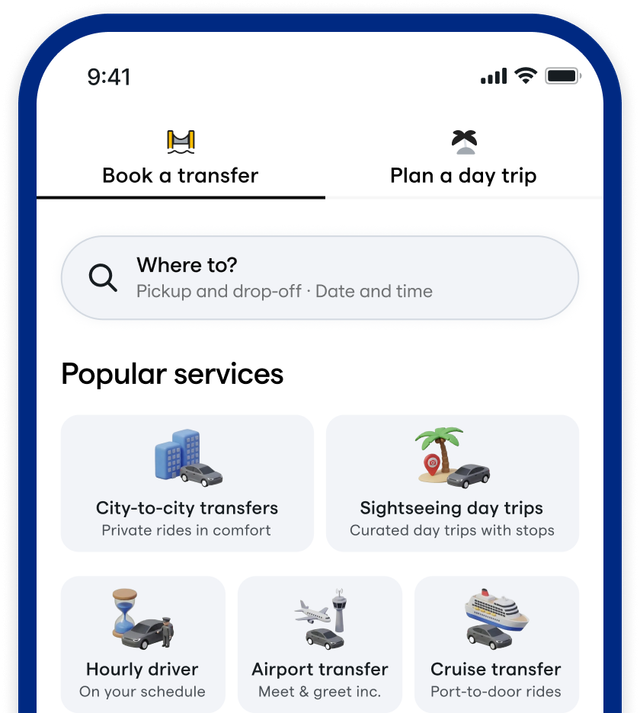
Allez n'importe où. L'application Daytrip le rend facile.
Réservez des transferts interurbains, explorez des arrêts incroyables, et voyagez facilement dans l'application Daytrip. Scannez le code QR, téléchargez l'application et commencez à explorer !
Questions fréquemment posées
Si vous avez des questions, voici les réponses.
Soyez le premier à découvrir plus
Recevez des idées de voyage soigneusement sélectionnées, des points forts d'initiés et des offres spéciales Daytrip.
Daytrip est une plateforme de service de voiture privée qui vous met en relation avec des chauffeurs locaux pour un transport porte-à-porte. Nous vous offrons également la possibilité de découvrir des sites et attractions en chemin. Nous conduisons, vous découvrez.
Daytrip propose des transferts privés porte-à-porte avec des arrêts touristiques optionnels, la location d’un chauffeur à l’heure, ainsi que des excursions d’une journée soigneusement sélectionnées — le tout avec des chauffeurs locaux anglophones et dans plus de 130 pays. Vous pouvez également réserver via notre application Daytrip, disponible sur l’Apple App Store et le Google Play Store.
La politique d’annulation peut varier en fonction de votre voyage. Les conditions d’annulation applicables à votre réservation seront toujours affichées avant la confirmation de votre voyage. Selon l’éligibilité, Daytrip propose différentes options d’annulation :
Non remboursable : Si votre voyage est annulé après confirmation, le montant payé ne sera pas remboursé.
Standard : Si votre voyage est annulé au moins 24 heures avant l’heure de départ prévue, le montant payé sera intégralement remboursé. Les annulations effectuées moins de 24 heures avant le départ ne donnent pas droit à un remboursement.
Flexible : Si votre voyage est annulé au moins 1 heure avant l’heure de départ prévue, le montant payé sera intégralement remboursé. Les annulations effectuées moins d’1 heure avant le départ ne donnent pas droit à un remboursement.
Les voyages réservés moins de 24 heures avant le départ peuvent ne pas être éligibles à une annulation gratuite, sauf indication contraire lors du processus de réservation.
Oui ! Réservez un transfert privé porte-à-porte depuis l’aéroport avec un chauffeur local anglophone. Profitez de tarifs fixes et transparents, sans frais cachés, et de la possibilité de payer à l’avance sans avoir à échanger de l’argent liquide dans un aéroport étranger.
Vous recevrez le véhicule le mieux adapté au nombre de voyageurs dans votre groupe, allant d’une berline à un van pour des groupes jusqu’à 7 personnes. Selon votre destination, vous pouvez réserver tout type de véhicule, d’une berline comparable à une Toyota Corolla à une Mercedes Classe V, ou encore une voiture cubaine classique. Bien que le modèle exact puisse varier, nous veillons toujours à ce que le véhicule fourni réponde à vos besoins en matière de sécurité, de fiabilité et de confort. Il est possible que vous soyez surclassé gratuitement dans une catégorie de véhicule supérieure selon la disponibilité. Comme notre plus grand véhicule peut accueillir 7 personnes, pour les groupes plus nombreux, une combinaison de véhicules sera utilisée. Nous vous enverrons les détails exacts du véhicule quelques jours avant votre voyage.
Partout sauf aux États-Unis, les chauffeurs fourniront des sièges enfants appropriés (il suffit de nous en informer lors de la réservation). Aux États-Unis, certains États exigent que vous apportiez vos propres sièges enfants.
Explorez 130+ pays avec nos transferts en voiture privée et excursions d'une journée
Je suis vraiment très heureuse d’être tombée sur ce site pour réserver deux transferts privés pendant ma visite à Lima, au Pérou. Il s’agissait de deux trajets aller simple d’environ trois heures chacun. La communication a été excellente dès que tout a été réservé par e-mail, puis j’ai téléchargé leur application. J’ai rencontré quelques problèmes avec l’application et le service client a été formidable pour m’aider à les résoudre. Honnêtement, le service client était impressionnant et m’a donné le sentiment d’avoir fait le bon choix. Les deux chauffeurs étaient parfaitement à l’heure, aucun problème ! Je ne peux pas dire assez de bien du service et de la simplicité de tout organiser lorsqu’on voyage aussi loin. Bravo à l’équipe Daytrip ! Je recommande vivement.
Oui, et c'est l'un des avantages pratiques d'un transfert privé avec Daytrip. Lorca se situe entre Murcie et Almería, ce qui en fait une étape intermédiaire naturelle lors d'un trajet plus long à travers le sud-est de l'Espagne. Vous pouvez demander un arrêt touristique à Lorca lors de votre voyage entre deux autres destinations, passer quelques heures à explorer le château et le centre historique, puis poursuivre jusqu'à votre destination finale — le tout en un seul trajet sans interruption avec le même chauffeur et le même véhicule.
Lorca se trouve dans la région de Murcie, dans le sud-est de l’Espagne. Depuis la ville de Murcie, la distance est d’environ 60 km, soit généralement une heure de route. Depuis Alicante, il faut compter environ 130 km, soit 1h30 à 2h selon la circulation. Depuis Almería, la distance est d’environ 100 km, soit 1 à 1h30 de trajet. Un transfert privé avec Daytrip vient vous chercher directement à votre hébergement, ce qui vous évite les correspondances, l’attente en gare ou la gestion des bagages.
Quatre à cinq heures à Lorca suffisent pour visiter confortablement les principaux monuments sans se presser. Le complexe du château à lui seul mérite une heure ou plus, compte tenu de sa taille et de ses vues. Le centre historique — avec les palais baroques de la Calle Corredera, la Collégiale de San Patricio, ainsi que les tours Espolón et Alfonsina — peut être exploré à pied en deux à trois heures supplémentaires. Arriver le matin vous permet de profiter de la meilleure lumière pour admirer les vues depuis le château et d’éviter la chaleur de midi en été.
Lorca est l'une des meilleures destinations purement historiques de la région de Murcie, précisément parce qu'elle n'a pas été façonnée par le tourisme côtier. La superposition archéologique y est exceptionnelle : bornes romaines, fortifications mauresques, tours post-Reconquista et siècles de construction d'églises chrétiennes coexistent à quelques pas les unes des autres. Si vous souhaitez comprendre comment la Reconquista a transformé une ville frontière au fil des siècles, ou découvrir une architecture civique baroque authentique dans son contexte urbain d'origine, Lorca offre une richesse que les stations balnéaires de la région ne peuvent tout simplement pas égaler.
Lorca a connu un essor de richesse aux XVIIe et XVIIIe siècles, ce qui a donné lieu à une concentration exceptionnellement dense d’architecture baroque civile et religieuse pour une ville de cette taille. Les familles nobles rivalisaient pour construire des palais et des façades toujours plus élaborés, laissant derrière elles un paysage urbain considéré comme l’un des plus beaux exemples du baroque espagnol en dehors des grandes capitales. Le tremblement de terre de 2011 a endommagé bon nombre de ces édifices, ce qui rend l’effort de restauration primé par le prix Europa Nostra—couvrant six églises historiques—une partie vivante de l’histoire que les visiteurs traversent aujourd’hui.
Lorca concentre une histoire extraordinaire dans un centre-ville compact. Peu de villes espagnoles peuvent se vanter d’une occupation continue depuis le Paléolithique, en passant par les époques romaine, mauresque et chrétienne — toutes visibles en une seule journée de promenade. L’emblématique château de Lorca domine la ligne d’horizon, tandis que le quartier historique alentour regorge de palais baroques, de couvents datant des XVIe au XVIIIe siècles, et de l’ancienne porte de la ville du Xe siècle. Lorca porte également une histoire remarquable de résilience : après le séisme de 2011, les travaux de restauration du patrimoine de la ville ont été récompensés par le prestigieux prix Europa Nostra, donnant à ses monuments une valeur authentiquement acquise et une signification vivante.