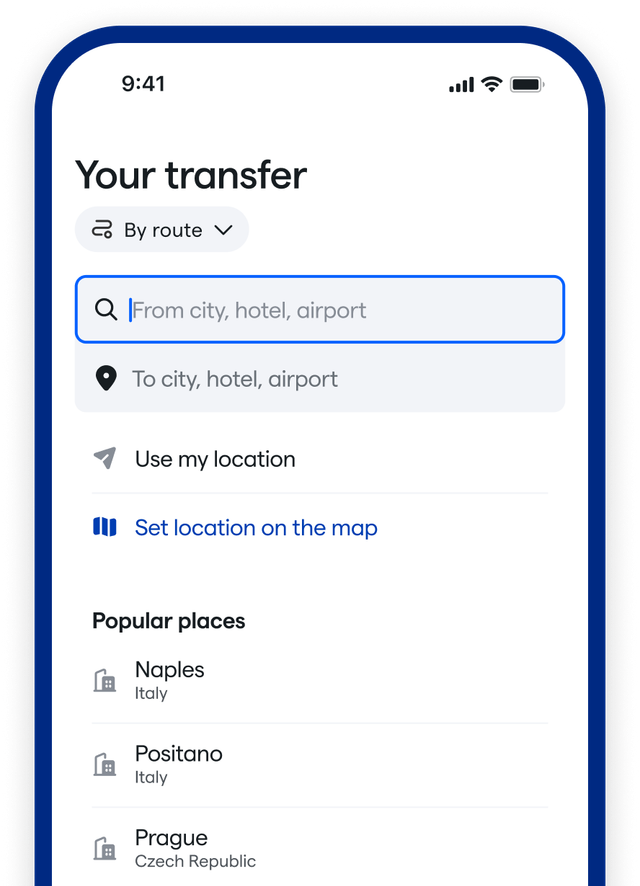
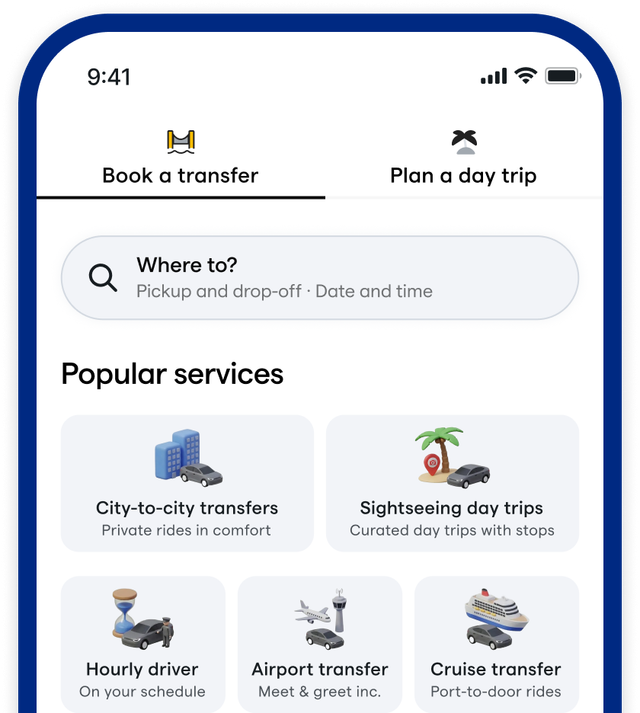
Daytrip is a private car service platform that connects you with local drivers who will transport you door-to-door. We also give you the opportunity to explore sights/attractions along the way. We drive, you discover.
Daytrip offers private door-to-door transfers with optional sightseeing stops, hourly driver hire, and curated day trips — all with local English-speaking drivers and operating across 130+ countries. You can also book on our Daytrip app, which is available on the Apple App Store and Google Play Store.
The cancellation policy may vary depending on your trip. The cancellation conditions available for your booking will always be shown before confirming your trip. Depending on eligibility, Daytrip offers different cancellation options:
Non-refundable: If your trip is canceled after confirmation, the amount paid will not be refunded.
Standard: If your trip is canceled at least 24 hours before the scheduled departure time, the amount paid will be refunded in full. Cancellations made less than 24 hours before departure are not eligible for a refund.
Flexible: If your trip is canceled at least 1 hour before the scheduled departure time, the amount paid will be refunded in full. Cancellations made less than 1 hour before departure are not eligible for a refund.
Trips booked less than 24 hours before departure may not be eligible for free cancellation unless stated otherwise during the booking process.
Yes! Book a private, door-to-door airport transfer with a local English-speaking driver. Enjoy fixed and transparent pricing, no hidden fees, and the option to pay in advance without the hassle of exchanging cash at a foreign airport.
You will receive the vehicle that best fits the number of travelers in your group, ranging from a sedan to a van for groups of up to 7. Depending where you travel, you can book anything from a sedan comparable to a Toyota Corolla to a Mercedes V-Class to a Classic Cuban Car. While the exact model may vary, we always ensure that the vehicle provided meets your needs in terms of safety, reliability, and comfort. You may be upgraded to a larger vehicle class free of charge depending on availability. Since our largest vehicle seats 7, for groups larger a combination of vehicles will be used. We will send you the exact vehicle details a few days before your trip.
Everywhere except the USA, drivers will supply appropriate child seats (just let us know during booking). In the USA, certain states require you to supply your own child seats.
Firminy sits roughly 72 km (45 miles) from Lyon and about 15 km (9 miles) from Saint-Étienne. A private transfer takes you door to door on your schedule, skipping the limited regional bus and train connections to a smaller town like this. It also means you can stop at other sights along the way rather than backtracking.
Most visitors find 2 to 3 hours enough to see the full complex, including the church interior, which is generally open to visitors. Guided tours are available and add useful context, since much of the design's meaning isn't obvious from the outside. It pairs well as a focused half-day stop rather than a full-day destination on its own.
Yes. The complex is as much a story as a building tour: a utopian housing experiment, a church left unfinished for decades, and concrete forms that critics still argue over today. Even without architectural background, the scale and boldness of the site make it a memorable, photogenic stop that's very different from the châteaux and old towns typical of a French day trip.
Firminy has 12th and 16th century churches, but the real draw is Firminy-Vert, Le Corbusier's built version of his "Ville Radieuse" ideal city. It's one of only 17 Le Corbusier works worldwide inscribed as a single UNESCO World Heritage Site in 2016. Where other stops offer medieval charm, this one offers a rare, complete vision of 20th-century utopian architecture in raw concrete.
Four structures make up the ensemble: the Unité d'Habitation housing block, the Maison de la Culture (a multi-purpose cultural house), an athletics stadium built into the hillside, and the Église Saint-Pierre, a striking cone-shaped concrete church. Together they form Le Corbusier's most complete surviving urban project.
Le Corbusier designed it in the 1960s but died before construction began. Work started in the 1970s, then stalled for political and funding reasons, leaving a half-built concrete shell for nearly 30 years. Architect José Oubrerie, Le Corbusier's former assistant, finally completed it in 2006, faithful to the original vision.